

Banksy Back Again
The anonymous artist's latest guerrilla sculpture shows he's really a lapdog at heart...

My thoughts on the new work by ‘Banksy’, found in St James’, London.
Don’t forget to like, share, subscribe, and share your thoughts in the comments!
In the early hours of Wednesday 29th April, under the cover of darkness, with only a large professional theatrical installations team, a multi-axle low-loader, and a hydraulic crane, the artist known as Banksy crept through the streets of central London. He was on his way to erect his latest work right in what used to be the heart of the establishment in about 1890. Outside of the scaffolding-shrouded Grecian façade of the Athenaeum Club, between memorials to such controversial and topic figures as Florence Nightingale, Edward VII, and Air Chief Marshall Sir Keith Park, Banksy placed a statue of his own - an unnamed work, cast in resin but meant to resemble bronze and stone, a business-suited male figure marching off the edge of his high plinth, blinded by the large blank flag he brandishes.
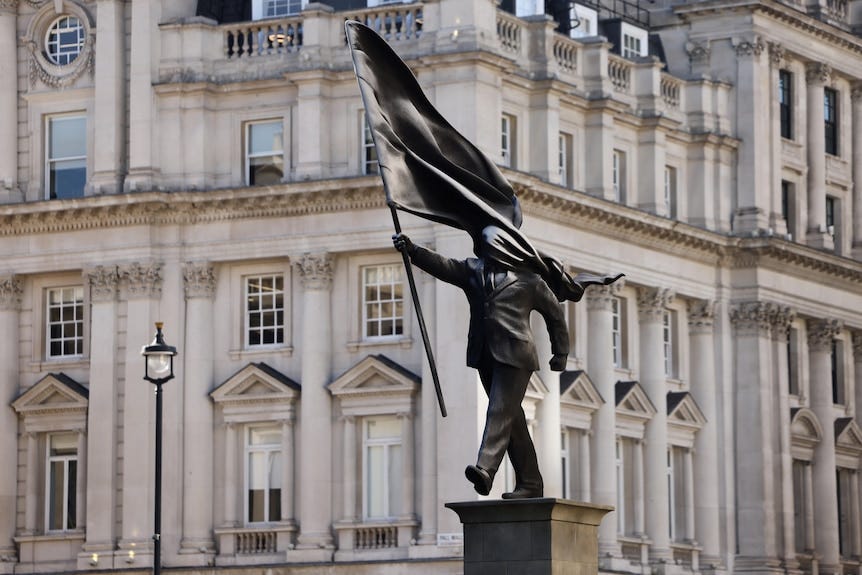
I have been critical of Banksy in the past, and as you will see through this article I will not be breaking the habit of a lifetime (for neither has he), but I must concede on this occasion he has, unusually, produced a work that is at least of formal interest. Most art with a primarily political dimension ends up sacrificing its visual interest in the aim of conveying a nuanced message - but then nuance has never been Banksy’s forte. The paintings by John Trumbull which occupy the rotunda of the US Capitol and show the founding political moments of the United States (‘The Signing of the Declaration of Independence’ etc.) have become part of the visual propaganda of America, but they are not Good Paintings. If it wasn’t for the political and historical importance of the events they depict, nobody would hold them up as masterpieces, and you will see them appear more often in straight history books than cultural commentaries. They’re functional, didactic, images which make no claims to aesthetic charm.
,_by_John_Trumbull.jpg)
That is one way political art can go, the other is when the aesthetic quality of the work drowns out the intended political message. A famous example of this is El Lissitzky’s Russian Civil War propaganda poster known as ‘Beat The Whites with the Red Wedge’. One can’t deny the abstract design is sharp and invigorating, the balance of forms and tones carefully balanced, it is often held up as an exemplar of Russian constructivist art…but its political message is vague and ambiguous. We might get a general feeling that the white circle (representing the Tsarist army) is the less dynamic of the shapes and appears to be lanced-through by the red wedge (the Soviets), but beyond that the message is lost. Swap the colours and the politics is turned on its head.

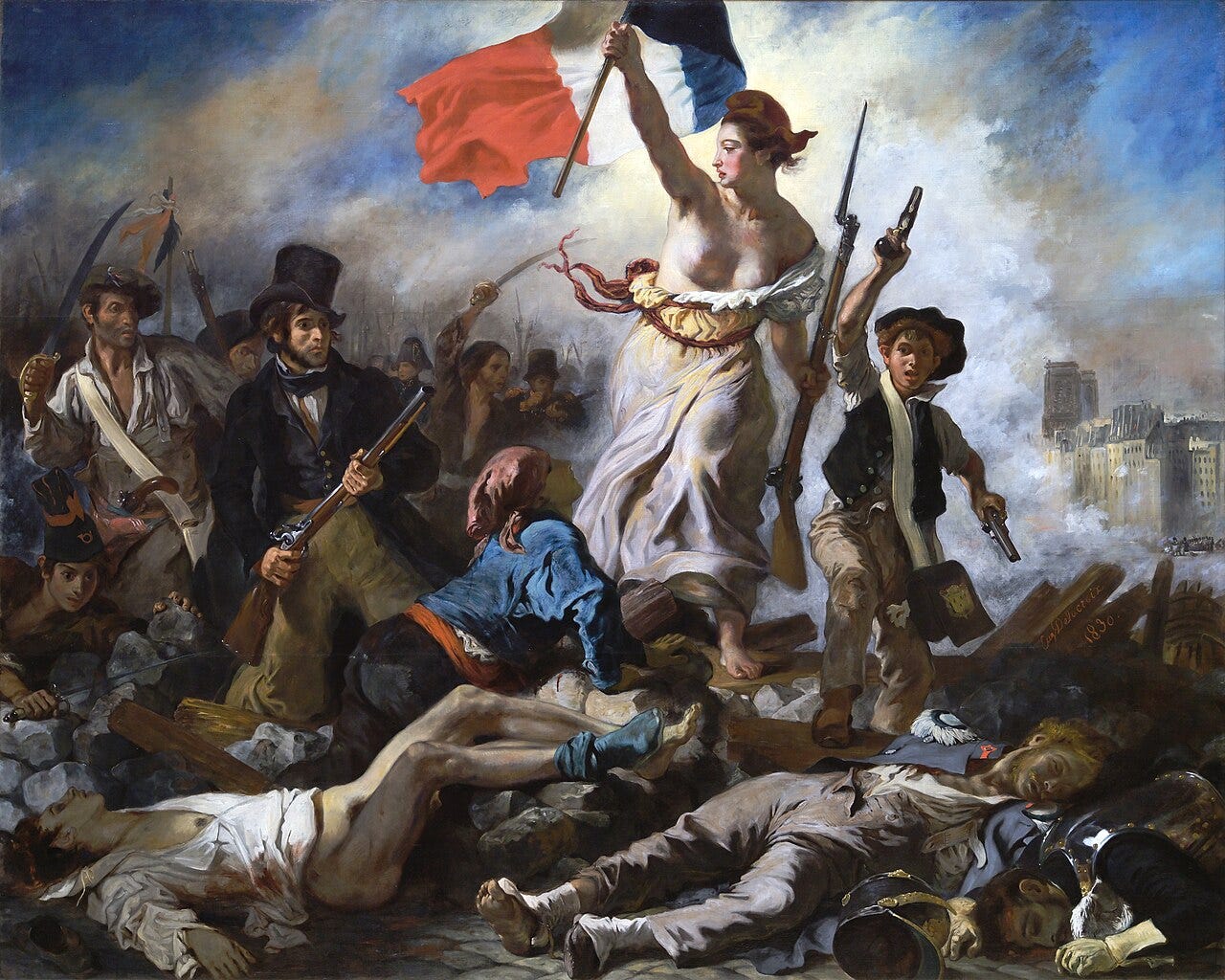
On the rare occasion when an artist manages the golden ratio of a Good work of art with a cogent political message it spooks people. Delacroix’s Liberty Leading the People inspires such deep seated feelings to climb barricades that the French government which bought it from the artists kept it hidden away from public view for decades, fearing its power. Banksy’s new sculpture is not one of these works.
It is a simple and bold image couched in the visual terms of public memorial we all recognise. The balanced forms of the outstretched flag-bearing arm, the other swung behind, and the marching leg hovering off the edge of the plinth are worthy of admiration. As is the rather satisfying display of almost baroque drapery in the flag’s folds and creases. Whether intentional or not, the quotation of the covered face from many marble busts of the shrouded Christ or the Virgin Mary places it nicely in a lineage of tradition. As works of sculpture go, it is certainly not bad.
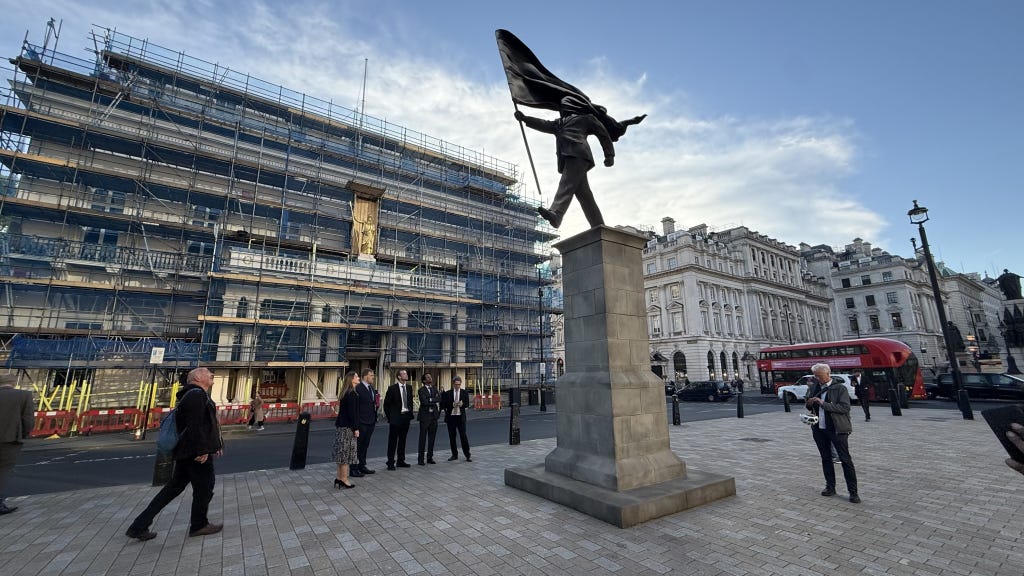
The problem comes when one tries to take in the political message of the work. We read the man in the suit as a politician, who, with bravado, is walking over the edge whilst made oblivious to the danger by the flag he carries which covers his eyes. Whilst Banksy himself has made no comment on its meaning the message seems pretty clear; nationalism is bad. For an artist who is invariably described as ‘subversive’ this is perhaps the most conventional and in-offensive statement he could have made. Yes, it’s true we might live in an age of rising nationalism across the world, with Trump in the White House and Farage’s party polling high, but this simplistic statement of primary colours politics is still the general position of almost all governments in Europe - and one that Keir Starmer, who can almost see this work from the garden windows of No.10, would applaud. It is also unlikely to ruffle any feathers in the global art market, who rely on Banksy as a rising tide that lifts all ships.
This is shock art which fails to shock; only to slightly surprise and amuse. It can’t even be claimed that Banksy has become a de-clawed lion as he has almost always presented ‘subversive’ art with a very simple and agreeable message; war bad, nature good, corruption bad, love good, oppression bad, childlike innocence good. Banksy has made a career, and inordinate amounts of money for himself and his collectors, by taking these generally uncontroversial and politically neutral sentiments and regurgitating them veiled in just enough easy-to-read symbolism and tongue-in-cheek-Radio-4-panel-show humour that we feel rewarded in having recognised our own opinions reflected back at us. You will note that on this new work the flag is blank so as not to particularly offend anyone, it could stand for any nation or party, and indeed I’ve already seen a bunch of AI edits online showing it to be a Trans flag, an Israeli flag, a Palestinian flag, an American flag, an EU flag, even an LGBTQ+ rainbow flag. If the work can mean anything then surely it means nothing?


The whiff of tame state approval around Banksy’s latest work (the epithet national treasure only alludes him thanks to the mask of anonymity) is enhanced by the pretence of the artist’s closest associates, the mandarins of the art market, and Westminster Council that they didn’t know this was coming. They’d like us to believe that someone can just rock up in central London and plonk down a statue without anyone being told or any permission sought, and the police, who crawl this governmental and royal neighbourhood of the capital 24/7 were left totally uninformed? A spokesperson from Westminster Council was quoted saying “We’re excited to see Banksy’s latest sculpture in Westminster, making a striking addition to the city’s vibrant public art scene” - gosh, how subversive! I wonder, if an artist had tried the same stunt with a statue that didn’t chime with the received wisdom, something overtly anti-Israeli or pro-Iranian, would the Council and the Mayor still be so ready to claim delighted ignorance?
In fact Banksy himself gave us an example of what happens in such circumstances. In September last year, again in central London, overnight there appeared on the front wall of the great gothic-revival Royal Courts of Justice a piece of classic Banksy stencil graffiti. It showed a judge, in full gown and wig, savagely beating with his gavel a young protestor on to the ground, blood splattered on their otherwise blank sign. As TimeOut put it “It’s one of Banksy’s grimmer murals, in stark contrast to the playful animal series of last summer.” It was immediately understood to be in response to the Labour government’s hard crack-down on the months of protest about Israel’s genocide of civilians in the Gaza strip - legislation which has since been struck down as an unlawful infringement of civil liberties. Two days before the graffiti appeared nearly 900 people had been arrested in a peaceful protest in Westminster.
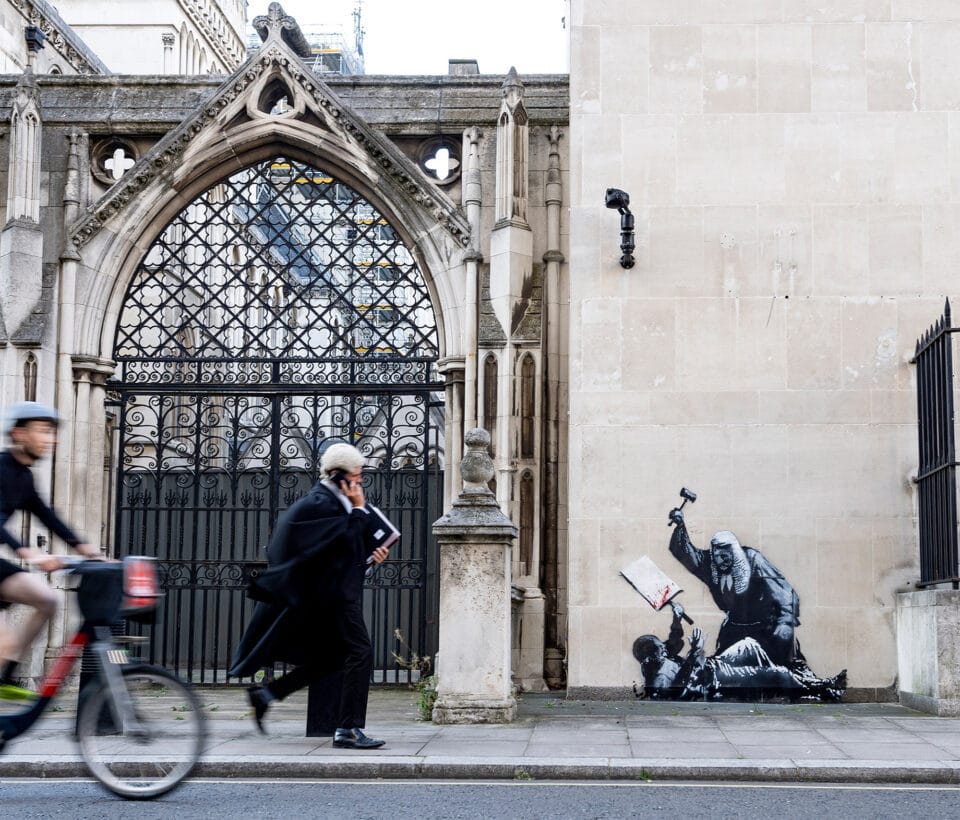
So how did the government, the council, the art market and the wider authorities respond to this “striking addition to the city’s vibrant public art scene”? It was reported as criminal damage to the Metropolitan Police, immediately covered from public view with 24hr security around it, before being pressure-washed off the wall within 48hrs of appearing. Too close to the bone for his handlers, but with this latest work, which is still there, and still attracting tourists like flies, more than a week after it appeared, he’s earned a gold star and a condescending pat on the head.
Perhaps it was the threat of the tabloid press unmasking his identity in the weeks after the Courts of Justice artwork which spooked him back into line, or perhaps this is where his politics truly lie - a safe, pragmatic, liberal centrism is nothing to be sneered at, but neither is it a source of searing or subversive artistic inspiration. Maybe it was in the early 1990s when he first started out, before the dollar signs became attached to his name, but art and politics have moved on at pace since then. The rough street-art aesthetic and guerrilla public installations have had their day and are now mundane. Banksy is suffering the same fate as so many artists before him, a slow fade into un-remarkableness, a waning of the powers, a sense of being outrun by events whilst simultaneously being adopted in the official culture of the age. He’s going out with a whimper rather than a bang.
Thank you for reading. Do you agree with my view on this artwork? Do you disagree or have other thoughts? Please do let me know in the comments!
Before you go, don’t forget to like and share this post, and subscribe to keep up to date with all my latest work.
All my writing here is free to read, but you can support my work by upgrading to a paid subscription - in return you get full access to the recordings of my monthly online art history talks.
Nice work. Thank you.
This was a good critique into how Banksy's new sculpture may not be as radical as it seems. I particularly liked you questioning how he and his team would have been able to place the sculpture in Waterloo Place undetected (I was thinking that as well before I got to this part of your post) and highlighting how the government's response contrasts with his graffiti work at the Royal Courts of Justice last year.
Admittingly, I think Lissitzky's "Beat the Whites with the Red Wedge" works well in conveying its political message. I find it to be rather straight to the point (both figurately and literally!). Nonetheless, I didn't know about this poster until now, so thank you for including it in your critique.